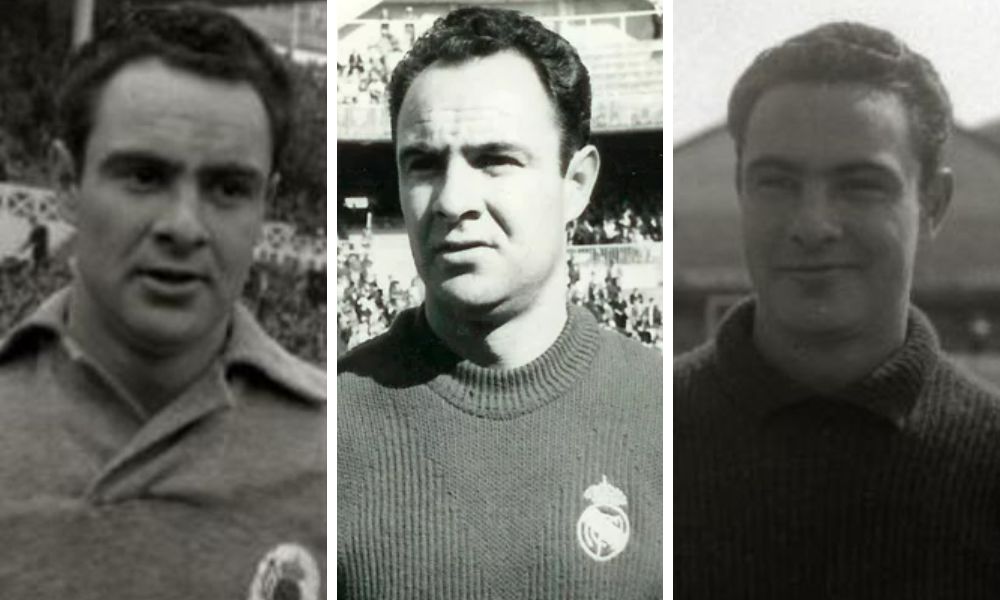
When it comes to legendary footballers from Menorca, there is one the stands out above the rest – goalkeeper Juan ‘Nito’ Bagur Coll.
Coll was one of the best Spanish goalkeepers of the 1950s and signed for Real Madrid in the midst of their glorious run of successive European Cup wins. In total, he played 151 matches in the Spanish top division between 1949 and 1961. He was called up to the Spanish national team on five occasions, but unfortunately never earned an international cap.
While modern goalkeeping has changed significantly to the traditional role of the shot-stopper, with a range of new goalkeeping techniques and tactics, Bagur’s record and honours stand proud in Menorcan terms in any era, and it will take a remarkable effort to surpass him as the island’s greatest.
From the beginning
Born in Ciutadella in March 28 1928, Coll started at Club Deportivo Robur, a modest club born within the Union of Former Salesians of Ciutadella, before moving on to Atletic Ciutadella, where he played the 1945/46 and 1946/47 season seasons, winning the Menorca League and Cup and finishing runner-up in the Balearic Islands.
After turning down Barcelona following a trial in 1947, Bagur signed a professional contract with Real Sociedad and though he was initially sent out on loan, he was brought back and made his first team debut in April 1948 against Sevilla in the Copa del Rey. With the coach disillusioned with their existing goalkeepers, Bagur quickly became number one and helped Sociedad win promotion back to the top flight as Second Division champions. He was the starting goalkeeper for Sociedad in seven out of 12 seasons, playing a total of 203 matches, 145 of them in the First Division.
Even today, he still ranks as the goalkeeper with the fourth most appearances for Sociedad. He was the club’s first ever non-Basque goalkeeper, and did hold the record of most appearances by a non-Basque goalkeeper, until he was beaten by Claudio Bravo in 2013.
During his time between the posts for Sociedad in the top division, they recorded finishes of 8th (1949/50), 10th (52/53), 9th (53/54), 14th (54/55), 8th (55/56), 12th (56/57), 9th (57/58) and 10th (58/59); and for the last three seasons, he was captain.
Making the move to Real Madrid
He made the move to Real Madrid in 1959 and in his first season was a member of the squad as they won a fifth successive European Cup, beating Eintracht Frankfurt 7-3 in the final in Glasgow with the likes of Alfredo Di Stefano, Ferenc Puskas and Paco Gento in the team. Bagur didn’t feature in the final itself, though revealed in a TV programme years later that he asked the coach Miguel Munoz to bring him on that day given the score, but the manager didn’t feel it appropriate.
Bagur played four times for Real Madrid, featuring in two league games and two cup games during his first season, where he was an understudy to the likes of Juanito Alonso, Rogelio Dominguez and Vicentre. During Bagur’s spell at the club, they also won the 1960 Intercontinental Cup, beating Penarol of Uruguay 5-1 at home following a goalless draw in the first leg.
Bagur became a Real Madrid history maker in 1960, when he became the oldest player to make his debut for the club at the age of 31 years, 9 months and 13 days old. That record stood for more than 40 years, until it was broken by Fabio Cannavaro in 2006.
After winning the league title with Real Madrid 1960/61, Bagur was relegated to fourth choice goalkeeper and left to join Racing Santander, making four appearances, before hanging up his boots at the age of 34 because of commitments to the family food business.
Missing out on international caps for Spain
Despite his presence in the top flight in the 1950s, Bagur never won an international cap for Spain. On a number of occasions, he was deputy to Atletic Bilbao goalkeeper Cedrun Carmelo, including a game at Wembley against England in 1955, where England beat Spain 4-1. Unfortunately, Bagur never came on for a minute of action for the national team.
Although Bagur himself never earned a cap for Spain, two of his deputies at Sociedad – Ignacio Eizaguirre and Jose Araquistain – did, somewhat reflective of his stature. It was the return of Eizaguirre from Valencia that meant after his first season in Sociedad, Bagur was demoted back to deputy, although the two would swap places again in 1953.
However, although specific details are sparse, it has been reported that Bagur received a permanent international player card from RFEF as a result of the ‘injustice’ of him never playing a minute for the national team.
He was an unused substitute in the 1954 World Cup qualifier against Switzerland, the play-off against Turkey and a friendly against Ireland in Dublin. In those days, substitutes were relatively uncommon, and so for Bagur to have travelled and be part of the match day squad and not make an appearance was extremely rare. The national team coaches for his call-ups were Luis Iribarren and Guillermo Eizaguirre.
There are mixed reports as to how many times he was called up – though it as at least four and could have been six.
Career stats and summary
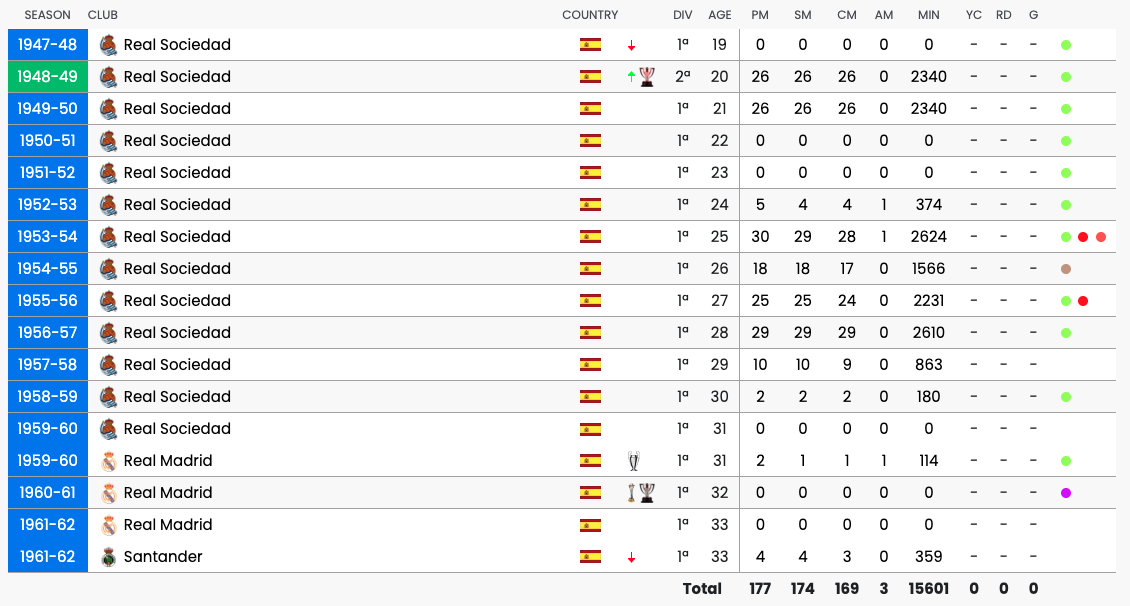
Juan Bagur Coll career stats, via BDFutbol
His honours were First Division (1960/61), European Cup (1959/60), Intercontinental Cup (1960), Second Division (1948/49)
Juan Bagur Coll lived on the island from the end of his playing career until he passed away on November 14, 2013 at the age of 85.